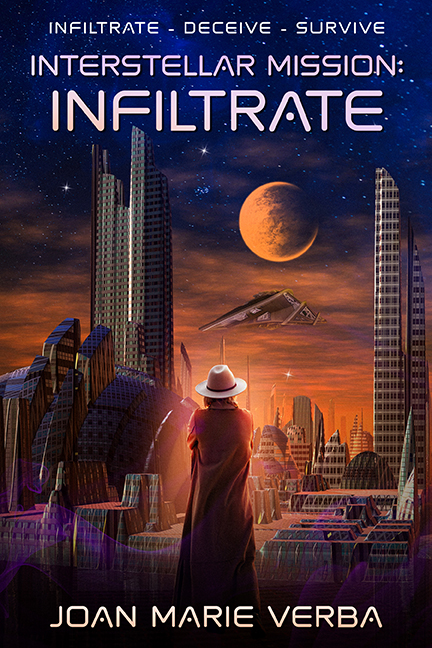


Chapter 1
Treason never entered the mind of Professor Thena Bridges as she checked the morning news headlines on May 5, 2084. Her attention focused on an article from the planet Corp. The government there had enacted a law banning people with disabilities from public spaces.
Checking her app giving the time on Corp, she saw that for Marilee Harrison, it was the middle of the night. Bridges would have to wait until late afternoon to call. Since the Corp government had threatened to pass such a law for months, Harrison and Bridges knew this could happen. They had discussed possible actions many times, since Harrison needed to wear an external frame on her legs in order to walk. One option was for Harrison to leave Corp and go to Glaicia. Just to be prepared, Bridges made a reservation for Harrison on the next scheduled transport from Corp to Glaicia and filled out the appropriate travel papers.
Having reassured herself she had done all she could for the moment, Bridges grabbed her gym bag and strode to the campus fitness center. Once there, she stood on her regular spot in the exercise room and began her usual routine.
The workout steadied her, allowed her to focus on the day’s tasks. When finished, she took her towel and wiped the sweat of exertion and the latest hot flash from her skin. As she stood there on the mat, she noticed a figure holding a knife creeping toward her out of the corner of her eye. Quickly, she twisted, disarmed the attacker, and threw him onto the mat.
Holding the wooden knife in one hand, she reached down with the other. “Really, Dale, was that necessary?”
He grinned at her as he took her hand and got to his feet. “Just wanted to see if you still remembered the self-defense lessons.”
She touched the scar at the top of her shoulder. “I doubt that I’d ever forget. I don’t want this to happen again.”
“It wouldn’t have happened if you hadn’t been in a conflict zone.”
She handed the wooden knife back to him. “Someone had to handle the negotiations. At least I persuaded the captors to release the hostages.”
“Are you going to miss the adrenaline rush after you retire?”
She laughed. “Not very likely.”
He clapped a hand to her forearm. “Good luck.”
“Thanks.” She headed to the showers as he walked away.
Wanting her final class to be perfect, she arrived in the lecture room well ahead of time. She wore her usual outfit: a knit shirt with the University’s logo, bought at the university bookstore, black slacks, cotton socks, and walking shoes. Accessing the controls on the wall, she turned on the captioning and descriptive technology. At the smartboard, she entered the passwords for the livestream so that the remote students could attend.
Descending the steps to the front of the room, she set up the hologram of herself on one side of the central aisle, and the hologram of her grandmother on the other side. Now everything was ready.
While she placed her purse and backpack in the locker at the side of the room, she heard a voice behind her.
“Professor, I have the sock crochet pattern I talked about.”
Bridges turned to see Jenny Singer talking to her hologram. Walking in that direction, she said, “Oh, that’s not me.”
Singer turned from the hologram to her and back again. She put a hand out and touched the hologram. “But it’s solid.”
“It’s a 3-D printed form of me with a hologram over it.”
Singer took a step back. “But it blinks. It breathes, or looks as if it’s breathing.”
Bridges smiled. “Technology. My staff taught me the basics when I was Director of Cybersecurity.”
Singer turned to the hologram again. “It’s very real.”
The hologram smiled. “I’m flattered,” it said in Bridges’s voice.
Singer chuckled and, reaching into her bag, turned to Bridges. “Anyway, here’s the crochet pattern I promised you.” She took out a datacard and handed it to Bridges.
Bridges took it and put it in a pants pocket. “Thank you.”
Singer climbed the stairs and took her usual seat. She pulled out her own crocheting from the bag and started working.
When the class had assembled, Bridges surveyed the attendees, both in-person and virtual.
“I’m happy to tell you that you all passed your finals.” She paused a moment while the students voiced happiness and relief. “As promised, this last class is an ‘ask me anything’ session.”
“Are there two of you?” Dylan, always ready to ask the first question, pointed from Bridges to her hologram and back.
Bridges chuckled. “Just showing off my holographic skills. I have a couple of my grandmother, too. One is for public presentations. The other my grandmother made at the oral history center just for me. She spent hours giving advice, relating family history, and so forth. I talk to her hologram often. We have nice conversations.”
“You said you’d show us your grandmother’s account of being the first human to see the Astirians,” Dylan said. “I presume that’s the one you save for public presentations?”
“Quite right.” Bridges walked over to the second hologram stand and activated it. An image of a wrinkled woman sitting in a chair faced the class. Grandma Andrea had recorded this when she was about the age as Bridges was now. They resembled each other strongly: same feathery gray hair, same pixie haircut. Bridges only hoped she could match her grandmother’s accomplishments.
The hologram began speaking:
I was sitting on a stone bench in the plaza of the Global Economic Council in Geneva, Switzerland, eating lunch. The plaza was empty due to a falling space debris alert. I felt the chances of debris hitting the Council headquarters was low, and since I was acting Vice-Chair of the Council, they couldn’t make me leave. The Chair remained in her office on the 40th floor. She and I were the only people in the vicinity.
I heard a whistle and looked up. A bright object, maybe a bolide, I thought, was falling from the clear sky. It was sunny. I gathered my lunch sack and was about to run when the object landed, softly and without a sound, maybe a couple of meters away. No crater, just sitting there. It was a clear sphere the size of a bowling ball. Then I heard what sounded like the crack of a whip, and suddenly what looked like a passenger car on a high-speed train appeared in the plaza. It did not descend from the sky; one moment the plaza was empty, and the next, it was filled by this contraption.
The door opened and three beings walked out. Heads shaped like bricks with rounded corners. Short fuzzy tan hair on top. Round black eyes, no pupils or irises. A bump of a nose with two nostrils. Thin lips. Otherwise, like humans: two arms, hands with five fingers and a thumb, two legs. Bronze skin. They each wore long-sleeved shirts with high collars in pastel colors and pants in dark colors. The shoes looked wooden, though I found out later they weren’t made of wood. Heights varied from about a meter and a half to two meters. They weren’t carrying weapons or bags, or wearing any jewelry.
They walked up to me and one of them said. “We come in peace. We wish to make an offer.” Their voices were slightly high-pitched, but understandable.
Before I could answer, the police arrived, sirens blaring. They thought someone was filming a science fiction movie without a permit. I told them that this wasn’t a movie set, they were with me, and I would take responsibility. The officers looked skeptical but left.
I escorted the Astirians inside. I had to use my highest clearance codes to get them past the security arch. Then we took the elevator to the chair’s office.
The rest you probably know from histories. Their society had built habitats on a dozen worlds and no longer found them profitable. They were looking for occupants. None of the other species they knew of showed an interest. But they knew of Earth from our broadcasts, and it seemed to them that humans were willing, even eager, to expand and make homes on other worlds. Would we consider taking over their habitats?
Of course we had questions. They assured us that the planets they offered were human-compatible in atmosphere, water, gravity, and biomes. They all had magnetospheres. All had moons: varying from one to several. Suns in the same class as ours. The habitats had renewable, environmentally-friendly ways of handling power, water, and waste control. They would instruct us how to use those and anything else. No, we would not be displacing any sentient species—-no sentient species had ever evolved on any of the planets, though they had evidence that other species may have visited eons ago. Only one habitat had been built per planet, in a place which would not disturb the local flora and fauna.
Just to be sure, we brought in scientists and technicians, who were just as interested in getting to know the Astirians as they were in vetting the planets they offered us.
At last, we signed an agreement with them. We would take over the occupation of the habitats, and screen any group wishing to manage a habitat. Earth would open up scientific and cultural exchanges with the Astirians, as well as trade opportunities. The Astirians would handle transportation between Earth and other planets, providing ships, pilots, and engineers.
The hologram faded.
“Did she remember them saying anything about dimensionality?” Dylan asked.
Bridges smiled. “Not on that particular day. The Astirians my grandmother met waited to explain dimensionality to us until after the agreements were signed. The late Professor Marsh, rest his soul, told me that no one fully understands dimensionality. Even Astirians tell us that their knowledge is incomplete. They discovered the in-between corridor by accident when in the process of designing propulsion for a starship that would convey them from planet to planet in less than a generation.”
Shiningstar, an Astirian who had taken the class so that she could work at an Astirian consulate or embassy on Earth, nodded.
Wren, a physics major taking the course because she intended to join teams analyzing phenomena on other planets, spoke up. “I was sorry to hear about Professor Marsh, too. When I was in his class, he said that it isn’t really another dimension you enter when taking a ship from planet to planet. Someone just called it that and the name stuck.”
“I don’t know what else you’d call it,” Quill said. Quill had been born on the planet Glaicia and lived on three other planets before enrolling in school on Earth. “Going from Earth to Mars, for instance. You can see Earth retreating. You can see the Moon as you go past. You can see the stars all around. You can see Mars approaching. But you aren’t in the vacuum of space. You’re someplace else. No telescope or radar can detect your ship. That’s another dimension to me.”
“How many planets have you been to, professor?” Shiningstar asked.
Bridges smiled. “Earth’s Moon and Mars, of course. Glaicia. Serenity….”
“How did you ever get into Serenity?” Rita asked. She was a political reporter for the University’s student newspaper. “I thought they had a long waiting list of women wanting to get in.”
“They invited me as a lecturer for a semester,” Bridges said. “The waiting list is for those who want to be permanent residents. It doesn’t apply to visitors.”
“What did you think?” Dylan asked.
“With all due respect to the men in the class, it was wonderful,” Bridges said. “Women all around, no having to be on guard for predatory men, no mansplaining….”
“No offense taken,” Dylan said. “We understand. I’d like Earth to be free of dickheads, too.” The other men in the class murmured agreement.
“You’ve been to Astiria, haven’t you?” Shiningstar asked.
“Yes,” Bridges said. “My grandmother took me to Astiria when I was a child. It’s a beautiful planet, very well maintained, environmentally responsible.”
“We try,” Shiningstar said.
Dylan turned to Shiningstar. “We humans think Astirians are great, but why don’t we see the other species you’ve told us about? Don’t they like us?”
“It’s not animosity,” Shiningstar said. “It’s lack of interest. They have the ability to contact humans if they want to. They just don’t want to. We contacted Terrans because you’re the only other species we know of who are as excited about exploring and visiting other worlds as we are. The other species can take it or leave it. They mostly leave it.”
Dylan turned to Bridges. “Speaking of other planets, what do you think of the doings on Corp? Do you think Earth will declare war?”
“I don’t know,” Bridges said. “But remember, an interplanetary war is not what you see in the movies. There won’t be spaceships firing energy bursts at other spaceships.”
“You can’t fire anything at all in the in-between place.” Wren said.
Bridges nodded. “Exactly. If Earth declares war on Corp, it will mean no travel and no trade between Earth and Corp. Earth’s only option after that is to send troops on Dimension Ships to Corp and fight on Corp’s grounds. Corp, knowing that, will remove their beacons. Without beacons to guide the D-Ships, the ships will be forced to attempt to reach Corp by trial-and-error, which could take years.”
“Decades!” Wren said.
“Right,” Bridges said. “Earth may try lower-level tactics first. Recalling ambassadors. Confiscating Corp assets here. Tariffs.”
Quinn turned to Bridges. Quinn was a graduate assistant and already taught freshman courses. “Don’t you wish the administration had named you National Security Advisor so that you could be in the thick of things?”
Bridges spread her hands. “I wanted the job, sure. But Terwilliger is more than competent.”
“Did you ever think of running for office?” Quinn asked.
Bridges shook her head. “I’m not warm and fuzzy enough. After the 1988 election between Bush and Dukakis, political satirist Mark Russell said that many Americans don’t want a president, they want a genial talk show host. I don’t fit that bill.”
“Wouldn’t you like a crack at Draik?” Quinn asked. “You’re known as the Dictator Whisperer, after all.”
“I’ve done my share of negotiating with tyrants. It’s not an easy job. Again, Terwilliger can handle it.”
“Didn’t you participate in debates where you argued in favor of the Executive Model, or to put it more bluntly, autocratic government?” Dylan asked.
“In my time, I debated both sides of several issues, whether I believed in the issue or not. You cannot effectively contradict the other side unless you know how they think, in depth. Knowing how authoritarians rationalize their behavior is key to getting what you want from them.”
“That Draik is one slippery guy, though,” Dylan said. “He’s convinced several celebrities to take his side and speak in favor of his policies.”
Bridges made a wide gesture. “I want you all to hear this. It’s important. Never, and I repeat, never, join a fascist regime. People think that joining a fascist cause keeps them safe. It doesn’t. Fascists eat their own. There will always be someone who thinks you’re not pure enough. Then you’re dead.”
A silence filled the room for a few moments.
Emery spoke up. Her career ambition was to be a community organizer. “I saw your interview on the ‘People You Should Know’ program.”
Bridges grinned. “Yes, that was fun.”
“How did you get your name?” Emery asked.
“My parents originally wanted to call me Athena, but after I was born, the registrar misheard and filled out ‘Thena’ on my birth certificate. When my parents commented on it, the registrar offered to change it, but they decided that ‘Thena’ was a good name, too, and kept it.”
“When did you realize you were ace/aro?” Cory asked. Cory had already been accepted into law school.
“Very early on. I’d watch movies when I was a child with people kissing and was puzzled at all the ‘mushy stuff.’ As teenager, when my classmates were swooning over the latest girl or boy band, I was completely uninterested.”
“But you do connect with people?” Cory said.
“Very deeply sometimes. Of the four loves C. S. Lewis mentions, I have experienced affection, friendship, and charity. I just leave out eros.”
“I understand you’re an amateur Tolkien and Lewis scholar?” Rowan asked. She had a tattoo in Quenya on her arm.
“Yes, I had my first paper published in Mythlore when I was fifteen. I belong to just about every Lewis and Tolkien interest group.”
“Which Narnia novel should one read first?”
“The Magician’s Nephew. No question.”
“Is The Silmarillion a great book or a terrible book?”
“Terribly great!”
“My betrothed and I got golden rings for our wedding, with the inscription just like in Lord of the Rings.”
Bridges rubbed her chin. “Not to ruin your romance, but you do realize that the ring you’re talking about is a symbol of evil?”
“We think of it as our love overcoming all forms of malice.”
“Then I wish both of you the best.”
“You said that you are a deist,” Cory asked. “Do you believe in a personal God?”
“I do. There have been times in my life when God was my only friend. I will hasten to add that I believe that your religion or lack of one is up to you, and I strongly support the separation of Church and State.”
Rita gestured at Bridges. Rita had taken the class because she planned to run for office. “That’s a lovely sun tattoo on the back of your hand. Where did you get it?”
Bridges held up her right hand and turned it so that the students could see it better. “This isn’t a tattoo. I was helping Professor Marsh with an experiment and this was the result.”
“Embedding tech into your hand so you can activate devices by pointing at them?” she asked.
“Something like that, except it didn’t quite work that way. It’s a lovely design, though, so I kept it.”
At that point, Zoe’s baby began to fuss. Zoe had set down the infant carrier in the aisle beside her chair.
Bridges walked up the stairs and faced Zoe. “Mind if I take him?”
“Please. I’m trying to take notes.” Zoe’s major was in data science.
Bridges lifted baby Sage and held him on her shoulder, patting his back. He quieted almost immediately.
Zoe smiled at Bridges. “The program said you were a babysitter when you were younger?”
“Yes, child care was my main source of income right through college. I get along well with children.”
“Ever think of adopting?”
Bridges shook her head. “No. In my work, I have had times where I packed up and moved on a moment’s notice. That’s no life for a child. They need stability.” She carefully placed Sage back in the carrier and offered the pacifier there. Sage sucked on it placidly.
Straightening up, Bridges looked around the class. “By the way, you’re all invited to my retirement luncheon in the student union at noon.” She started down the stairs again.
“What are you planning to do with all your free time?” Dylan asked.
After taking a deep breath, Bridges said, “I hadn’t given it much thought yet. Decompress. Catch up on my crocheting. Compose another Tolkien or Lewis paper. Maybe write a memoir.”
“I’d read it!” Cory said. Other class members cheered in agreement.
“Thank you,” Bridges said. “You’ve all been wonderful students. I know that all of you have bright futures ahead of you. It’s been a pleasure to mentor you, and have made this past semester the best of my long career. Class dismissed.”
The students applauded. Many of the students, both remote and in-person, extended congratulations and good wishes as they filed out. When the classroom had emptied, she gathered her things and walked out into the hall.
Almost immediately, she was confronted by Winston Sterling, a student of hers who had not attended the class.
“I want to talk to you, professor.”
“You’re talking to me. Go on.”
“You gave me an F.”
“I did. Your homework was uninspired and I recognized the styles from various paper mills and AI generators. You did not participate in the few classes you attended.”
He frowned. “I had important things to attend to.”
“Boat racing on the Mississippi?”
He snorted.
“I have made allowances for students with ADHD, dyslexia, cancer, pregnancy, and a host of other genuine challenges. I do not make allowances for those who are lazy and entitled.”
“I can sue you.”
She laughed in his face. “Every case brought against me was dismissed with prejudice. I’ll see you in court.” Without an “excuse me” she elbowed her way past him and stalked off.
With an hour or so on her hands before the retirement luncheon, Bridges entered a student bistro and ordered tea. Few students lingered there, not surprising on the last day of class. She sat at a small round table with two chairs and set her tea and smartphone on the surface. Checking the time, she realized that Harrison must still be asleep. It would be dangerous to try to contact her in a public setting, in any case. She started to check the news sources for any developments on Corp.
Presently, she became aware of someone walking toward her table. Looking up, she saw a man of shorter-than-average height approaching. Round face, round cheeks, white hair, balding on top. If he had a beard, he could have been a department store Santa from central casting.
He stopped and bowed slightly when he reached her table. “Professor Bridges? I am Herman Schloss, a great admirer of yours. May I sit for a moment?”
Bridges gestured at the other chair.
He sat. “I know your time is valuable, so I will get straight to the point. I have a job offer for you.”
She smiled and shook her head slightly. “Sorry, I’m retired.”
He smiled back. “Oh, I think you will like this offer.” He set his phone on the table and began to swipe through images. “Generous salary. Includes a luxury multi-room suite in a high-rise building, furnished, rent-free. Your own car.”
Bridges craned her neck to look at the images. “What sort of job is this?”
“The best. You’ll be second-in-command to the planet’s executive.”
“Which planet?”
“Corp.”
Bridges laughed in his face. “You’ve got to be kidding! Draik would never choose someone like me to be in his cabinet.”
He manipulated the phone. “You argued very well for the executive model of governance.”
“That was a debate. An intellectual exercise.”
“How about when you were head of cybersecurity? I understand your staff said you ran the place like a drill sergeant.”
“I run a tight ship. But I always gave them credit for work well done, and all of them said they’d work for me again when my term ended. I even sent them off with glowing and well-earned recommendations for their next jobs.”
He inclined his head and winked. “Of course.”
Bridges sighed.
He held out his phone. “Watch the video and see what you think.”
She almost refused, but curiosity overcame her. When she started the video, she saw the face of Gustav Draik, close up. A handsome man, his straight black hair was worn short, and he had a neatly trimmed black goatee. “Professor Bridges, I sent this video with Mr. Schloss so that you would know my offer is genuine. Please perform any checks you need to do on his phone to verify that my message is not AI-generated. On Earth, your talents are undervalued. You know it, everyone knows it. You were made for greatness! Here you would be rewarded according to your brilliance. I know that you would contribute to making Corp the most glorious world in the galaxy. All you need to do is tell Mr. Schloss that you accept my offer and he will make all the arrangements. I look forward to seeing you soon.”
When the message ended, she performed all the checks to ascertain that the video was not a deepfake. It turned out to be authentic.
She handed the phone back to Schloss.
He smiled, wearing an eager expression. “And your answer is…?”
“Go to hell.”
The smile never faded. “If I recall correctly, Milton wrote, ‘In hell at least we shall be free. Better to reign in hell than to serve in heaven.’” He touched his phone to hers. “You have my number. Call anytime, day or night.” He stood, bowed politely, and sauntered away.
She snorted and checked the screen to confirm that her phone had picked up his contact information. Her first thought was to forward everything to law enforcement. On second thought, he had not done anything technically illegal, just made a job offer. Still, it might be worth forwarding to Earth’s security offices so he could be added to a watchlist.
Remembering her retirement luncheon, Bridges checked the time. However she chose to respond, it would have to wait.
Certainly, at this point, treason never entered her mind.